The nation may have gotten a terrible jobs report for August, but there was one part of the economy that’s doing pretty well. Unemployment among government workers is at 5.1 percent, the lowest in the nation.
The unemployment rate for government wage and salaries workers dropped from 5.7 percent in July to 5.1 percent in August. At the same time, the number of government wage and salary workers counted as unemployed dropped by 123,000 people from 1,182,000 in July to 1,059,000 in August.
The Bureau of Labor Statistics counts someone as a government wage and salary worker if they are not in the military and they are currently employed by any level of government—local, state or federal—or they are unemployed, they are looking for work and their last job was for any level of government.
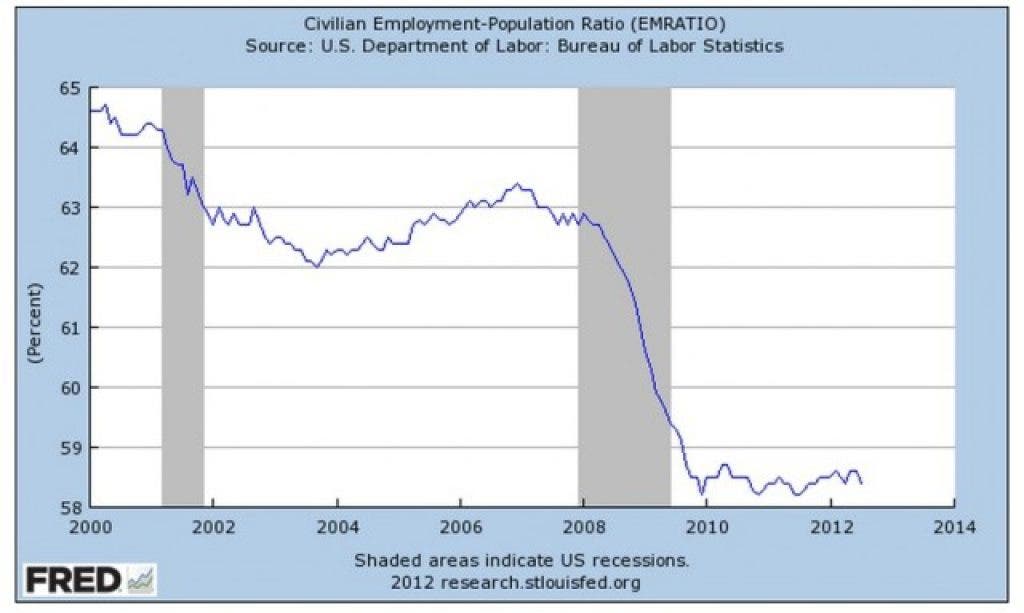
If the job participation rate (the number of Americans considered to be in the work force) were the same as when President Obama took office, the unemployment rate would be 11.2 percent. We are now at the lowest level of civilian employment as a percent of the total since we began keeping statistics. Perhaps, just perhaps, there is a relationship between the lack of civilian jobs and the increase in government employment.
For every new program that Local, State or Federal government initiates, there is a new bureaucracy and wave of hiring. If you’re not in government and not in the half that pays no taxes, you’re paying for it.
emratio drops during recessions. I assume because of the loss of private sector jobs. For some strange reason, the y axis of your graph is zoomed in to a 7% window. weird. I attached a longer view of the graph you cited.
Unless I am mis-interpreting the graph thaqt Bryon sent, Mr Lowry has made a fundamental error. Also, as the population ages and retirement increases, the percentage of adults working will decrease. This seems to be an even larger factor than the large decrease in government jobs in the last 4 years.
Total nonfarm payroll employment rose by 96,000 in August. I don't believe this qualifies as a terrible jobs report. Not great, but certainly not terrible. What would be terrible: How about on October 2, 2009 when the Bureau of Labor Statistics released the employment situation report for September, 2009 marking the 21st month of consecutive job loss, the longest streak in 70 years. 263,000 jobs were shed in September and the unemployment rate rose to 9.8%. The employment loss was larger than expected, and the only reason unemployment did not rise more was the fact that 571,000 workers dropped out of the labor force. The labor force was 615,000 workers lower than it was a year earlier, dropping 0.4%. Mike.... come on.
Net/Net: We are producing more unemployed each and every month. Tell me again how that is good?
He also presents an argument that something is wrong when government unemployment is 5% while private sector is higher. The problem with his assertion is that unlike the private sector, demand for government services doesn't decrease during a recession but actually stays the same or increases. As such, it's reasonable for government unemployment to be more recession proof than the private sector. Lastly, everyone should find his final comment referring to the "50%" who don't pay taxes offensive. This "statistic" is flawed! Most of that 50% do pay taxes...payroll, sales, gas and more. They contribute to the govt! They may not pay income taxes because they simply make too little or are retired and have already paid their fair share! If you're looking for deadbeats, there are 16000 who make more than $250k but pay no US income taxes!
To solve our fiscal problems...eliminate preferential taxation of certain income (i.e. capital gains/dividends), limit amounts that can be deferred into IRA/401K/retirement accounts, tax foreign earnings of businesses, close the tax gap by requiring 1099's for all business purchases > $1,000, limit charitable deductions to $50,000 per year, limit mortgage interest to $30-40K per year, limit miscellaneous itemized deductions to $10-20K per year, eliminate bonus depreciation and curtail section 179 deductions, tax gains on sale of personal residences, subject stock options to payroll taxes, limit the foreign tax credits used by high net worth citizens, tax unrecognized gains of appreciated assets given to charity, close the carried interest "loophole", reduce military spending...I can keep going.